FAQs
Most conventional sprinkler heads will discharge between 40 and 120 litres of water per minute, depending on the type of system.
Most modern sprinkler or mist systems require relatively little maintenance to function properly all year.
No, BS 9251 and BS8458 is exclusively intended for use in residential and domestic settings.
No, each sprinkler or Mist Nozzle is a self-contained heat detector that will only activate when a certain temperature is reached.
The external diameter of most flameproof cpvc pipework in domestic premises is either 28mm or 35mm.
Pipework in conventional domestic and residential fire sprinkler systems typically comprises of flame-resistant cpvc which has limited flexibility although more flexible than copper pipework.
Most domestic systems require approximately 1200 litres of water weighing approximately 1.2 tonnes of water.
The installation method is similar to that of plumbing or electrical work. There are three stages: first fix, second fix, and commissioning.
As early in the build as possible because the sprinkler system design must be submitted to the Building Control Officer for approval, we encourage our customers to seek written confirmation of any variations from British Standard BS9251 for approval by the BCO.
A fire sprinkler system requires a large amount of water with a specified level of pressure behind it, known as dynamic pressure.
The policies of water companies regarding domestic and residential fire sprinkler supply vary greatly, and our knowledge in this area allows us to provide recommendations based on current trends.
Most houses are defined as ‘category one’ in which case except for restrooms under 5m2 and cupboards with a floor surface of less than 2m2, BS 9251 requires sprinkler protection in all portions of the structure (with a few minor exceptions). However, the BCO routinely grants exceptions to this rule.
No. Sprinklers activate quickly and only where needed, using less water than fire hoses.
They are checked twice a year to ensure they are functioning correctly, however, commercial sprinkler systems can require daily, weekly, and monthly checks.
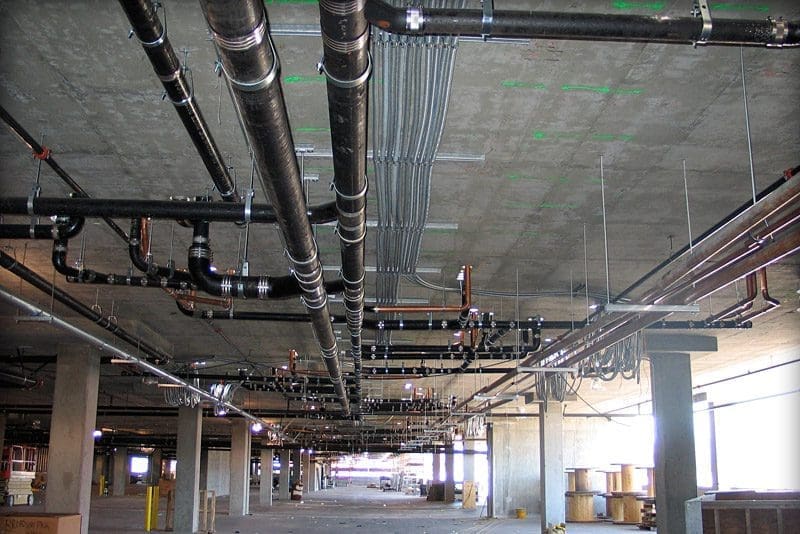
No. Systems designed for homes (BS 9251 and BS8458) are not suitable for car parks.
Sprinkler heads are temperature-controlled nozzles with heat-sensitive elements that release water at a specific temperature, usually 68°C or 74°C.
No. Each sprinkler head is a self-contained heat detector that only activates when a specific temperature is reached. Only the sprinklers closest to the fire will activate.
The pipework in domestic fire sprinkler systems is typically 28mm or 35mm external diameter. High-Pressure Mist systems have the advantage of requiring smaller holes, usually less than 25mm.
Conventional sprinkler systems use flame-resistant CPVC (chlorinated polyvinyl chloride) pipework, which has limited flexibility. High-Pressure Mist systems, on the other hand, use pre-engineered hoses that are much more flexible, making them ideal for retrofitting.
Installation happens in three stages: first fix, second fix, and commissioning, similar to plumbing or electrical work. The pipework for fire sprinkler systems is often slightly larger than standard plumbing pipes.
It's best to involve a contractor as early as possible in the building process. The sprinkler system design needs approval from the BCO, and early involvement allows for better planning and coordination particularly regarding water supplies.
Fire sprinkler systems need a large volume of water at a specific pressure. Conventual standard household water supplies are designed to restrict large flows of water to prevent damage resulting from a serious blow-out. This renders a standard domestic supply unsuitable for conventional sprinklers. However, in these cases, a High-Pressure Mist system is the best solution.
Water company policies on fire sprinkler supply vary significantly. Due to the high flow rates required, it’s often not possible to use the existing water supply for a conventional retrofit system. The options are usually a new water supply or a storage system. However, High-Pressure Mist systems can easily run on a standard 22mm domestic supply and often on an 18mm domestic supply. For new builds, connecting directly to the mains supply is usually possible with early planning and obtaining advise from local water undertakers.
While adding water to a fat fire can be dangerous, the large volume from a sprinkler head quickly cools the fire and starves it of oxygen, effectively extinguishing it.
A mains-fed sprinkler system runs until it’s isolated, but modern systems include control circuits that activate sounders to alert nearby individuals. While some versions of the BS 9251 standard no longer require external alarms, installing a sounder on the exterior of your property is recommended for added security.
A mains-fed sprinkler system runs until it’s isolated, but modern systems include control circuits that activate sounders to alert nearby individuals. While some versions of the BS 9251 standard no longer require external alarms, installing a sounder on the exterior of your property is recommended for added security.
That’s correct, but fire sprinklers help here too. By suppressing the fire early, they reduce combustion and the resulting smoke. Additionally, the water droplets from sprinklers limit smoke spread.
No. Fire sprinklers rely on heat sensors, not smoke sensors, for activation. They are designed to account for normal heat fluctuations from cooking or open flames.
Fire sprinklers cause far less water damage compared to uncontrolled fires or even the water used by firefighters. They release water directly over the fire, minimizing the affected area.
Yes, they’re widely used in North America, Australia, New Zealand, and many European countries, where residential fire safety is a top priority.
Smoke alarms increase your survival chances in a fire by about 60%. However, having a fire sprinkler system boosts this figure to roughly 95%, as it actively suppresses the fire, reducing its spread and impact.
While individual sprinkler heads can’t be tested after installation, each head is rigorously tested during manufacturing. System functionality, including water pressure and flow, is confirmed during installation and through equivalence testing.
Accidental activation is extremely rare. Unlike smoke alarms, which can be triggered by burnt toast, fire sprinklers respond solely to significant heat levels caused by an actual fire.
Most domestic properties fall under 'category one', meaning they require sprinkler protection in all areas except for restrooms under 5m² and cupboards smaller than 2m². However, the Building Control Officer (BCO) can grant exceptions to this rule. It is crucial to contact your BCO early on to determine the level of protection needed for your specific property.
No, this is a common misconception. Each sprinkler head operates independently, activating only when it detects heat in its vicinity (around 68°C). In most cases, one or two sprinklers are sufficient to extinguish a fire.
Most domestic systems require around 1,000 gallons (1,200 litres) of water, weighing approximately 1.2 tonnes. If installed in the loft, 'coffin' water tanks can distribute the weight across multiple joists.

Get Help And Advice
Get in touch today to protect your property with a professionally installed fire sprinkler system. Our expert team is here to answer your questions and provide a tailored quote.